Choosing the right screen printing emulsion is one of the most important decisions in the screen preparation process. The emulsion you select can directly affect stencil durability, image quality, exposure performance, print consistency, and overall production efficiency.
Among the most commonly used options are photopolymer emulsions and Diazo emulsions. While both are used to create durable stencils for screen printing, they have different characteristics, applications, exposure requirements, and performance advantages.
So, which one is best?
The answer depends on your printing process, ink system, required production volume, exposure equipment, and the type of artwork you need to reproduce.
In this guide, we will compare photopolymer and Diazo emulsions, explain how they work, discuss their advantages and limitations, and help you choose the right screen printing emulsion for your application.
What Is Screen Printing Emulsion?
Screen printing emulsion is a light-sensitive coating applied to a mesh screen to create a stencil.
During the screen preparation process, the emulsion is coated onto the mesh and allowed to dry. A transparent film containing the desired artwork is then placed on the coated screen. When the screen is exposed to ultraviolet (UV) light, the exposed areas of the emulsion harden.
The unexposed areas are washed out with water, creating open mesh areas through which ink can pass during printing.
The result is a stencil that allows the printer to reproduce the desired image, design, text, or pattern on a substrate.
Screen printing emulsions are widely used for:
- Textile printing
- Garment printing
- Graphic printing
- Industrial printing
- Signage printing
- Packaging applications
- Ceramic printing
- Promotional product printing
- Specialty printing
The right emulsion can help printers achieve better image reproduction, improved stencil durability, and consistent production results.
What Is Photopolymer Emulsion?
Photopolymer emulsion is a screen printing emulsion technology that uses photopolymer chemistry to create a photosensitive stencil.
Photopolymer emulsions are generally known for their fast exposure characteristics and ease of use. They are commonly selected for applications where printers need efficient screen preparation and consistent stencil performance.
Depending on the formulation, photopolymer emulsions can be designed for different ink systems and printing applications.
Key characteristics of photopolymer emulsions include:
- Fast exposure
- Good image resolution
- Consistent stencil formation
- Easy processing
- Good edge definition
- Efficient screen preparation
- Suitable for high-quality printing applications
Photopolymer emulsions can be particularly useful in commercial printing environments where production efficiency and repeatability are important.
What Is Diazo Emulsion?
Diazo emulsion is a two-component or sensitized screen printing emulsion system that uses Diazo compounds as a photosensitizer.
Before use, the Diazo sensitizer is typically mixed into the base emulsion according to the manufacturer’s instructions. After sensitization, the emulsion becomes light-sensitive and can be applied to the screen for stencil production.
Diazo emulsions have been widely used in screen printing for many years and are valued for their versatility and durability.
They can be suitable for a variety of applications, including textile, graphic, and industrial screen printing.
Key characteristics of Diazo emulsions include:
- Good stencil durability
- Broad application versatility
- Good resistance to certain ink systems
- Reliable stencil performance
- Suitable for a range of printing applications
- Good option for printers working with different production requirements
Because Diazo emulsions generally require sensitization and may have longer exposure times than some photopolymer systems, the preparation process can be more involved.
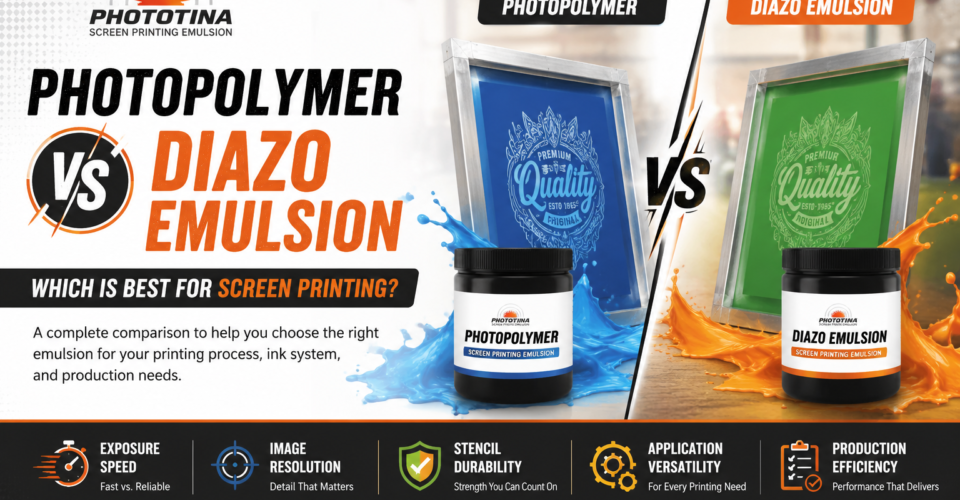
Photopolymer vs Diazo Emulsion: Key Differences
The main difference between photopolymer and Diazo emulsions is their chemistry and the way they respond during exposure.
Here is a general comparison:
| Feature | Photopolymer Emulsion | Diazo Emulsion |
| Exposure speed | Generally faster | Generally slower |
| Preparation | Usually simpler | Requires sensitizer mixing |
| Image reproduction | Excellent | Very good |
| Exposure control | Relatively straightforward | Requires careful exposure |
| Production efficiency | High | Moderate to high |
| Stencil durability | Depends on formulation | Generally very good |
| Application versatility | Depends on product | Broad application range |
| Best suited for | Fast, consistent production | Versatile and durable stencil applications |
The actual performance of any emulsion depends heavily on its formulation, mesh, coating technique, exposure unit, ink system, and printing conditions.
Therefore, it is important to select an emulsion based on the complete printing process rather than choosing only by emulsion type.
1. Exposure Speed
One of the biggest differences between photopolymer and Diazo emulsions is exposure speed.
Photopolymer emulsions are generally designed for faster exposure. This can be beneficial for commercial printers handling multiple screens and looking to reduce screen preparation time.
Diazo emulsions typically require more exposure time, although the exact exposure depends on factors such as:
- Emulsion thickness
- Mesh color
- Mesh count
- Exposure unit
- UV light intensity
- Distance between the light source and screen
- Artwork density
For high-volume production environments where fast screen turnaround is important, a photopolymer emulsion may provide an efficiency advantage.
2. Image Resolution and Detail
The ability to reproduce fine details is critical in many screen printing applications.
Photopolymer emulsions are often preferred for applications requiring:
- Fine lines
- Small text
- Detailed graphics
- Halftones
- High-resolution artwork
Their fast and controlled exposure characteristics can help produce sharp stencil edges when the screen is properly coated and exposed.
Diazo emulsions can also produce excellent image quality when properly prepared and exposed. They may be suitable for applications where fine detail is required but extremely fast exposure is not the primary concern.
The final image quality depends on much more than the emulsion itself. Mesh selection, coating technique, artwork quality, exposure accuracy, and screen tension all play important roles.
3. Stencil Durability
Stencil durability is particularly important for printers handling long production runs.
A durable stencil should withstand:
- Repeated squeegee pressure
- Ink contact
- Cleaning
- Solvents or chemicals, depending on the application
- Long production runs
Diazo emulsions have traditionally been valued for their stencil durability and versatility.
However, modern photopolymer emulsions can also provide excellent durability when the formulation is matched correctly to the ink system and printing application.
For solvent-based or chemically aggressive applications, printers should consider a solvent-resistant screen printing emulsion specifically designed for the intended ink system.
4. Ease of Preparation
Photopolymer emulsions generally offer a simpler preparation process because they are often supplied ready to use or require minimal preparation.
Diazo emulsions typically require the sensitizer to be mixed with the base emulsion before use.
The sensitization process needs to be carried out carefully according to the manufacturer’s instructions.
For printers prioritizing a simplified workflow and faster screen preparation, photopolymer emulsions may be more convenient.
For printers who value versatility and are comfortable with sensitizer preparation, Diazo emulsions remain a practical option.
5. Shelf Life and Storage
Proper storage is important for both photopolymer and Diazo emulsions.
The shelf life of an emulsion depends on the specific formulation and manufacturer’s recommendations.
General storage considerations include:
- Keep the emulsion in a suitable temperature-controlled environment.
- Protect it from direct sunlight and UV exposure.
- Keep containers properly closed when not in use.
- Follow the manufacturer’s recommended storage temperature.
- Avoid contamination during handling.
- Check the product’s recommended shelf life before use.
Diazo emulsions may require additional consideration after sensitization because their usable life can differ from the unsensitized base.
Always follow the technical data sheet and manufacturer’s storage instructions.
6. Compatibility With Different Ink Systems
One of the most important factors when choosing an emulsion is ink compatibility.
Different printing inks have different chemical properties. A screen printing emulsion that works well with one ink system may not perform equally well with another.
For example, printers may work with:
- Water-based inks
- Plastisol inks
- Solvent-based inks
- UV-curable inks
- Specialty inks
When selecting an emulsion, always check whether it is designed for the specific ink system being used.
For example, a printer using solvent-based inks may require a solvent-resistant screen printing emulsion, while a printer working with water-based textile inks may need an emulsion formulated for suitable water resistance and production requirements.
Photopolymer vs Diazo: Which Is Better for Textile Printing?
Textile printing requires careful consideration of ink type, stencil durability, mesh selection, image detail, and production volume.
Photopolymer emulsions can be a strong choice for textile printers who need:
- Fast exposure
- Efficient screen preparation
- Consistent image reproduction
- High production productivity
- Fine image detail
Diazo emulsions may be suitable for textile printers looking for:
- Versatility
- Durable stencils
- Reliable performance
- Broad application compatibility
The best choice depends on the printing process and ink system.
For water-based textile printing, the emulsion should provide appropriate resistance to the ink and washing conditions encountered during production.
Photopolymer vs Diazo: Which Is Better for Industrial Printing?
Industrial screen printing can involve demanding applications where stencil performance and chemical resistance are critical.
Industrial printers may use screen printing for:
- Electronics
- Glass
- Ceramics
- Automotive components
- Industrial labels
- Control panels
- Membrane switches
- Specialty products
In these applications, the emulsion should be selected based on:
- Ink chemistry
- Solvent resistance
- Required stencil thickness
- Image resolution
- Production volume
- Exposure equipment
- Required stencil durability
For demanding solvent-based applications, a solvent-resistant emulsion may be more appropriate.
For applications requiring high production efficiency and precise image reproduction, a suitable photopolymer emulsion may offer advantages.
The best solution should always be determined through application testing.
How to Choose the Right Screen Printing Emulsion
Choosing the right emulsion is not simply a matter of selecting photopolymer or Diazo.
Consider the following factors.
1. Identify Your Ink System
Start by identifying the type of ink you use.
Ask:
- Is it water-based?
- Is it solvent-based?
- Is it plastisol?
- Is it UV-curable?
- Does it contain aggressive solvents?
The emulsion must be compatible with your ink system.
2. Consider Your Printing Volume
If you are producing a large number of prints every day, exposure speed and stencil durability may be major considerations.
High-volume printers may benefit from an emulsion that offers:
- Fast exposure
- Consistent processing
- High durability
- Reliable repeatability
3. Consider the Level of Detail
For detailed graphics and fine artwork, look for an emulsion that provides:
- High resolution
- Excellent edge definition
- Good exposure latitude
- Consistent stencil formation
Your mesh selection is also critical for achieving the desired image quality.
4. Evaluate Your Exposure Equipment
Your exposure unit has a major influence on emulsion performance.
Before choosing an emulsion, consider:
- UV light source
- Light intensity
- Exposure distance
- Exposure time
- Screen mesh color
- Coating thickness
An emulsion that performs well on one exposure system may require different exposure settings on another.
5. Consider Stencil Durability
For long production runs, the stencil must withstand the printing process.
If the stencil breaks down or deteriorates during production, it can result in:
- Poor print quality
- Production delays
- Screen replacement
- Increased material consumption
- Higher operating costs
Choose an emulsion that matches the expected production conditions.
Common Problems Caused by Incorrect Emulsion Selection
Using the wrong emulsion can lead to several screen printing problems.
Stencil Breakdown
The emulsion may deteriorate during printing if it is not compatible with the ink system.
Poor Image Resolution
Incorrect coating or exposure may result in loss of fine details.
Pinholes
Pinholes can occur due to contamination, dust, improper screen preparation, or coating issues.
Difficult Washout
Underexposure or incorrect processing can make the stencil difficult to wash out.
Excessive Exposure
Overexposure can make fine details difficult to open during washout.
Poor Stencil Adhesion
Improper screen preparation or unsuitable emulsion selection can affect adhesion to the mesh.
Many screen printing problems are caused by a combination of factors, so troubleshooting should consider the complete screen-making process.
How to Improve Screen Printing Emulsion Performance
To get consistent results from any emulsion, printers should follow good screen preparation practices.
Clean the Mesh Properly
The mesh should be clean and free from grease, dust, oil, and contaminants.
Use the Correct Coating Technique
Maintain consistent coating pressure and technique.
Control Emulsion Thickness
The required emulsion thickness depends on the application and desired ink deposit.
Use Correct Exposure Settings
Perform exposure tests to determine the appropriate exposure time for your equipment and emulsion.
Maintain Proper Screen Tension
Consistent mesh tension helps improve print quality and registration.
Follow Manufacturer Guidelines
Always follow the manufacturer’s technical recommendations for sensitization, coating, exposure, drying, and storage.
Photopolymer or Diazo: Which One Should You Choose?
There is no universal answer to which emulsion is best.
Choose a Photopolymer Emulsion When:
- Fast exposure is important.
- You need efficient screen preparation.
- You require consistent image reproduction.
- Your production process involves frequent screen preparation.
- You need good resolution and detail.
- The emulsion is compatible with your specific ink system.
Choose a Diazo Emulsion When:
- You need a versatile emulsion system.
- Stencil durability is a priority.
- You are comfortable with sensitizer preparation.
- Your application requires a traditional, reliable emulsion technology.
- The product is compatible with your ink and printing process.
Consider a Specialty Emulsion When:
Your application requires specific performance characteristics, such as:
- Solvent resistance
- Water resistance
- UV ink compatibility
- High-resolution printing
- High-build stencil thickness
- Specialized industrial printing
Ultimately, the best screen printing emulsion is the one that delivers the right balance of exposure performance, stencil durability, image quality, chemical resistance, and workflow efficiency for your specific application.
Frequently Asked Questions
Is photopolymer emulsion better than Diazo emulsion?
Not necessarily. Photopolymer emulsions are often preferred for fast exposure and efficient processing, while Diazo emulsions are known for versatility and durable stencil performance. The right choice depends on the application, ink system, exposure equipment, and production requirements.
What is the main advantage of photopolymer emulsion?
The main advantage is generally faster exposure and efficient screen preparation. Photopolymer emulsions can also provide excellent resolution and consistent stencil formation when properly processed.
What is the main advantage of Diazo emulsion?
Diazo emulsions are widely valued for their versatility and durable stencil performance across various screen printing applications.
Which emulsion is best for textile screen printing?
The best emulsion depends on the textile ink system, production volume, required detail, and exposure equipment. For water-based textile printing, choose an emulsion designed to provide suitable resistance and durability for the application.
Which emulsion is best for solvent-based inks?
A solvent-resistant screen printing emulsion specifically designed for the solvent system should be considered. Always verify compatibility with the particular ink and solvent being used.
Can photopolymer emulsion be used for industrial printing?
Yes. Suitable photopolymer emulsions can be used for various industrial printing applications, provided the emulsion is compatible with the ink system and production requirements.
How do I choose between photopolymer and Diazo emulsion?
Consider your ink type, exposure equipment, production volume, required image detail, stencil durability, and chemical resistance requirements. Testing the emulsion under actual production conditions is often the best way to determine suitability.
Final Thoughts
Both photopolymer and Diazo emulsions have an important place in modern screen printing.
Photopolymer emulsions can be an excellent choice for printers who prioritize fast exposure, efficient processing, and consistent image reproduction.
Diazo emulsions can be a reliable option for applications requiring versatility and durable stencil performance.
The most important factor is not simply choosing between photopolymer and Diazo. It is selecting an emulsion that is correctly matched to your ink system, mesh, exposure equipment, printing process, and production requirements.
For professional screen printers, textile printers, graphic printers, and industrial printing companies, choosing the right emulsion can help improve stencil quality, reduce production problems, and achieve more consistent printing results.
If you are looking for a reliable photopolymer emulsion manufacturer or Diazo emulsion supplier in India, it is important to work with a manufacturer that understands different screen printing applications and can recommend a suitable solution based on your specific requirements.
Photokina Chemicals Private Ltd. provides screen printing chemical solutions for a range of printing applications. Contact the Photokina Chemicals team to discuss your screen printing emulsion and chemical requirements.
CTA
Looking for the right screen printing emulsion for your application? Contact Photokina Chemicals Private Ltd. to discuss your requirements and explore suitable screen printing chemical solutions.