Textile screen printing continues to be an important printing method for garments, fabrics, promotional apparel, uniforms, home textiles, and other textile products. From creating detailed artwork to producing consistent prints across large production runs, the quality of the final result depends on several factors, including the printing process, equipment, ink, screen preparation, and the materials used.
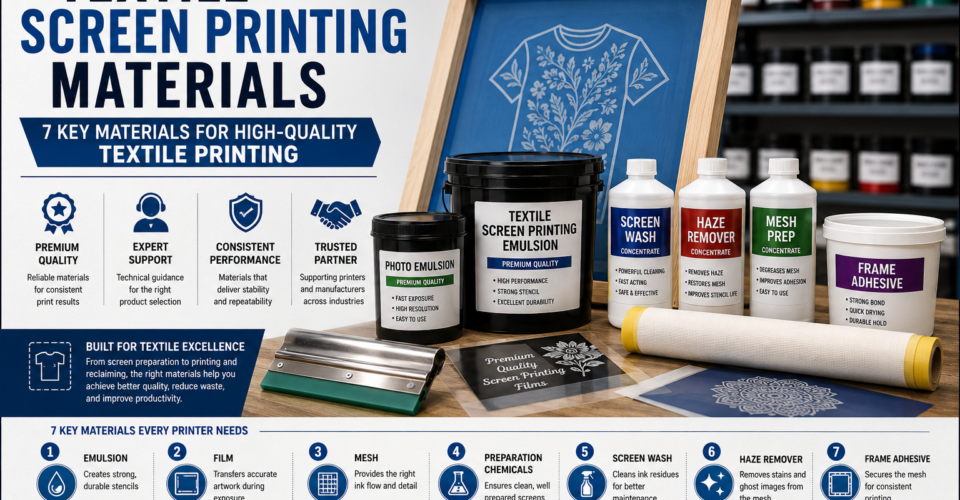
Choosing the right textile screen printing products is particularly important because different fabrics, designs, inks, and production requirements can require different approaches. Screen printing materials such as emulsions, films, mesh, screen cleaning chemicals, haze removers, and frame adhesives each play a specific role in preparing and maintaining screens.
For textile printers, garment manufacturers, screen-making professionals, and printing businesses, understanding these materials can make it easier to select suitable products and develop a consistent workflow.
In this guide, we explore 7 key materials used in textile screen printing, explain their applications, and discuss how to select the right products for different printing requirements.
What Are Textile Screen Printing Products?
Textile screen printing products are the materials, chemicals, and accessories used during different stages of the screen printing process for fabrics and textile substrates.
The process can involve several stages, including:
- Preparing the screen
- Cleaning and degreasing the mesh
- Applying emulsion
- Creating the stencil
- Exposing the artwork
- Developing the screen
- Printing the design
- Cleaning the screen
- Reclaiming the screen for future use
Each stage can require specific materials. Selecting products that work well together can help create a more controlled and repeatable screen printing process.
Common textile screen printing products include:
- Screen printing emulsions
- Screen printing films
- Screen printing mesh
- Screen preparation chemicals
- Screen wash
- Haze remover
- Frame adhesive
- Squeegees and other screen printing accessories
The right combination depends on the type of textile, artwork, ink system, production volume, and desired print characteristics.
Why Are the Right Textile Screen Printing Products Important?
The screen is one of the most important components of the screen printing process. It determines how the artwork is transferred and how ink passes onto the textile.
Using unsuitable or incompatible materials can contribute to problems such as:
- Poor stencil adhesion
- Loss of fine details
- Inconsistent ink deposits
- Screen staining
- Difficulty reclaiming screens
- Premature stencil breakdown
- Uneven print results
- Increased material waste
On the other hand, selecting materials according to the printing application can help create a more consistent workflow.
It is important to remember that screen printing is a system. Emulsion, film, mesh, ink, exposure, squeegee, substrate, and cleaning processes all interact with one another. Therefore, choosing one material in isolation may not solve a printing problem.
7 Key Textile Screen Printing Materials for Better Printing
1. Textile Screen Printing Emulsion
Screen printing emulsion is one of the most important materials used to create a stencil.
The emulsion is applied to the screen mesh and exposed to light through the artwork. During development, the required image area is opened, allowing ink to pass through the stencil during printing.
For textile applications, the appropriate emulsion can depend on factors such as:
- Type of textile printing
- Ink system
- Mesh specifications
- Required image detail
- Exposure equipment
- Production volume
- Desired stencil durability
A suitable emulsion can support clear image reproduction and stencil performance when used with the correct mesh, coating, and exposure process.
What Should You Consider When Choosing Emulsion?
Before selecting a textile screen printing emulsion, consider:
Ink compatibility: Different ink systems may have different requirements.
Image detail: Fine artwork may require suitable stencil characteristics for accurate reproduction.
Exposure conditions: The emulsion should be compatible with the exposure equipment and process.
Stencil durability: Production requirements can influence the type of emulsion required.
Mesh: The emulsion and mesh should be considered together rather than independently.
For businesses purchasing textile screen printing products, choosing an emulsion based on the actual application is generally more useful than selecting one only by price.
2. Screen Printing Film
Screen printing film is used to transfer artwork onto an emulsion-coated screen during exposure.
The film contains the image that determines which areas of the stencil are exposed and which areas remain available for ink transfer.
The quality of the film can therefore influence the reproduction of artwork.
A suitable screen printing film can be important when working with:
- Fine lines
- Small text
- Detailed artwork
- Halftones
- Multi-colour designs
- Repeat printing
When selecting film, printers should consider image quality, opacity, dimensions, exposure requirements, and compatibility with their screen preparation process.
Why Is Film Quality Important?
A poorly prepared or unsuitable film can make it difficult to reproduce artwork accurately.
For textile printing, particularly where designs contain fine details, the relationship between artwork, film, emulsion, mesh, and exposure settings should be carefully managed.
Consistent film preparation can contribute to more repeatable stencil production.
3. Screen Printing Mesh
Mesh provides the surface on which the stencil is created.
Mesh selection can affect ink transfer, image detail, and stencil performance. One of the most commonly discussed mesh characteristics is mesh count.
In general, different mesh counts can be used for different printing requirements. The choice should consider:
- Artwork detail
- Ink characteristics
- Desired ink deposit
- Textile substrate
- Printing technique
- Stencil requirements
Why Does Mesh Count Matter?
A mesh with a different count can influence the amount of ink passing through the screen.
For example, applications requiring a heavier ink deposit may have different mesh requirements from applications requiring fine details.
However, mesh count should not be selected by following a single universal rule. Printers should evaluate the complete printing setup, including ink, emulsion, artwork, squeegee, and textile.
Mesh and Emulsion Work Together
The relationship between mesh and emulsion is particularly important.
The emulsion needs to coat the mesh appropriately and form a stencil capable of withstanding the intended printing process.
Therefore, when purchasing textile screen printing products, it can be useful to evaluate mesh and emulsion as part of the same screen preparation system.
4. Screen Preparation Chemicals
Screen preparation chemicals are used at different stages of preparing a screen for printing.
Depending on the workflow, these products can support processes such as:
- Mesh cleaning
- Degreasing
- Screen preparation
- Emulsion preparation
- Screen cleaning
- Stencil removal
- Screen reclaiming
Proper screen preparation can help reduce contamination and improve consistency.
Why Is Screen Preparation Important?
Before applying emulsion, the mesh should be properly prepared according to the recommended process.
Contamination, oils, dust, or residues can interfere with the screen preparation process and may affect stencil adhesion.
A consistent preparation routine can therefore be useful for businesses producing multiple screens every day.
Establish a Standard Process
Textile printing businesses can benefit from establishing standard procedures for:
- Mesh cleaning
- Degreasing
- Drying
- Emulsion coating
- Exposure
- Development
- Inspection
- Printing
- Cleaning
- Reclaiming
A standardized workflow can make it easier to identify where problems occur and reduce unnecessary variation between screens.
5. Screen Wash
After printing, screens need to be cleaned before they can be stored or reclaimed.
Screen wash is used to help remove residual ink from the screen.
Effective screen cleaning can be particularly important for businesses that reuse screens regularly.
Screen wash may support:
- Ink removal
- Screen cleaning
- Faster screen maintenance
- Preparation for reclaiming
- Better screen housekeeping
Why Should Screens Be Cleaned Properly?
Residual ink can make the subsequent reclaiming process more difficult. It can also contribute to staining and unwanted residues.
The appropriate cleaning product should be selected according to the ink system and the manufacturer’s recommendations.
Printers should also follow appropriate handling, storage, and safety instructions when using chemical cleaning products.
6. Haze Remover
Haze is a common concern when screens are repeatedly used and reclaimed.
After ink and stencil removal, residual stains or ghost images can sometimes remain on the mesh. A suitable screen printing haze remover can be used as part of the screen reclamation process to address these unwanted residues.
Haze remover may be useful when:
- Screens are frequently reclaimed
- Previous designs leave stains
- Ghost images remain visible
- Mesh needs to be prepared for a new stencil
- Screen appearance needs to be restored
Haze Removal and Screen Reclaiming
Haze removal is generally one part of a broader screen reclamation workflow.
A typical process may include:
Ink removal → Stencil removal → Cleaning → Haze treatment if required → Washing → Drying → New screen preparation
The exact process depends on the materials, ink system, emulsion, and equipment being used.
Following the product instructions is important because different chemical products can have different application requirements.
7. Frame Adhesive
Frame adhesive is used to attach screen printing mesh securely to the frame.
A stable mesh-to-frame connection is important because screen tension and stability can influence printing performance.
Frame adhesive can be particularly relevant for businesses that stretch and prepare their own screens.
What Should You Consider When Choosing Frame Adhesive?
Consider factors such as:
- Frame material
- Mesh type
- Bond strength
- Application method
- Drying or curing requirements
- Compatibility with the screen preparation process
Using a suitable adhesive can help maintain the integrity of the screen during printing, cleaning, and reclaiming.
How to Choose Textile Screen Printing Products
Choosing the right materials requires more than simply comparing product prices.
Here are several factors textile printers should evaluate.
1. Identify the Textile
Different textile substrates can have different printing characteristics.
Consider whether you are printing on:
- Cotton
- Polyester
- Blended fabrics
- Synthetic textiles
- Garments
- Home textiles
- Specialty fabrics
The substrate can influence ink selection, mesh requirements, stencil characteristics, and printing parameters.
2. Understand Your Ink System
Ink compatibility is one of the most important considerations when selecting screen printing materials.
Before purchasing an emulsion or cleaning chemical, determine which ink system is being used and check the relevant technical recommendations.
This can help reduce compatibility-related problems.
3. Consider Artwork Complexity
A simple logo may have different requirements from detailed artwork containing small text, fine lines, gradients, or halftones.
When printing detailed artwork, pay particular attention to:
- Film quality
- Mesh selection
- Emulsion characteristics
- Exposure
- Screen coating
- Development
A coordinated process is more effective than changing only one material.
4. Consider Production Volume
Small print shops may have different requirements from high-volume garment printing facilities.
Higher production volumes can increase the importance of:
- Consistent materials
- Reliable product availability
- Repeatable screen preparation
- Efficient cleaning
- Screen reclaiming
- Technical support
Supplier reliability can therefore become an important factor in purchasing decisions.
5. Evaluate Product Compatibility
Whenever possible, consider how different products will work together.
For example:
Mesh + Emulsion + Film + Exposure + Ink + Cleaning Process
These components are interconnected. A change in one part of the process can affect other stages.
Textile Screen Printing Products for Garment Printing
Garment printing is one of the most common applications where screen printing is used.
T-shirts, uniforms, promotional apparel, sportswear, workwear, and other garments can require different printing approaches depending on the fabric and artwork.
For garment printing, printers may need to evaluate:
- Textile type
- Ink system
- Mesh count
- Emulsion
- Film
- Stencil durability
- Ink deposit
- Squeegee characteristics
- Curing requirements
For repeat production, consistency is particularly important.
A screen that produces one successful print but performs inconsistently during a large production run may create unnecessary waste.
This is why choosing suitable textile screen printing products should be part of a broader production strategy.
Common Textile Screen Printing Problems
Even when quality materials are used, incorrect process settings can create problems.
Poor Emulsion Adhesion
Possible causes can include inadequate mesh preparation, contamination, incorrect coating conditions, or unsuitable product selection.
Loss of Fine Details
This can be influenced by film quality, mesh, emulsion, exposure, artwork preparation, and development.
Uneven Ink Deposit
Squeegee pressure, angle, speed, mesh, ink characteristics, and stencil conditions can all influence ink deposit.
Screen Staining
Repeated printing and reclaiming can result in residual stains. Proper cleaning and, when appropriate, haze treatment can help manage these issues.
Stencil Breakdown
Stencil durability can be influenced by exposure, emulsion selection, ink chemistry, cleaning methods, and printing conditions.
Instead of changing products immediately, printers should evaluate the complete process to identify the underlying cause.
How to Improve Textile Screen Printing Quality
Using good-quality materials is only one part of achieving consistent results.
Printers should also focus on process control.
Maintain Consistent Screen Preparation
Use a standard process for cleaning, coating, exposing, developing, and inspecting screens.
Keep Mesh Clean
Proper cleaning can help reduce contamination and improve screen preparation.
Maintain Equipment
Exposure units, coating tools, squeegees, printing equipment, and washing systems should be maintained according to their requirements.
Monitor Screen Condition
Inspect screens before printing and after reclaiming.
Follow Technical Data
Always follow the manufacturer’s recommendations regarding application, storage, handling, mixing, exposure, cleaning, and other product-specific requirements.
Record Successful Settings
For repeat jobs, recording successful mesh, emulsion, exposure, and printing parameters can make future production easier to reproduce.
Why the Right Supplier Matters
A reliable supplier can be an important part of a textile printing operation.
Instead of looking only at product price, businesses should consider:
- Product range
- Technical information
- Product compatibility
- Supply consistency
- Packaging options
- Application support
- Product availability
- Industry experience
A supplier offering a range of textile screen printing products can make it easier for printers to source different materials required for screen preparation and maintenance.
For businesses with regular production requirements, consistent sourcing can also simplify procurement.
How Photokina Chemicals Can Support Screen Printing Requirements
Photokina Chemicals Private Ltd. operates in the screen printing chemicals and materials segment, offering products used across different stages of screen preparation, printing, cleaning, and reclaiming.
Its product range includes categories related to screen printing emulsions, films, screen cleaning, haze removal, frame adhesives, and other screen-making auxiliaries.
For textile printers researching screen printing materials, understanding the specific requirements of their printing process is the first step toward selecting suitable products.
Businesses can review product specifications and choose materials according to their application, ink system, mesh, artwork, and production requirements.
Frequently Asked Questions
What are the main textile screen printing products?
Common products include screen printing emulsions, films, mesh, screen preparation chemicals, screen wash, haze removers, frame adhesives, squeegees, and other accessories.
Which emulsion is best for textile screen printing?
There is no single emulsion that is best for every textile application. The choice depends on the ink system, mesh, artwork, exposure equipment, stencil requirements, and production conditions.
Why is screen printing emulsion important?
Emulsion is used to create the stencil through the exposure process. Its characteristics can affect image reproduction, stencil durability, and compatibility with the printing process.
What is screen printing film used for?
Film carries the artwork used during the exposure process. It helps create the stencil on the emulsion-coated screen.
What is haze remover used for?
Haze remover is used during screen reclamation to address residual stains or ghost images that can remain on the mesh after printing and cleaning.
How can I select the right textile screen printing products?
Start by identifying the textile, ink system, artwork requirements, production volume, mesh, exposure equipment, and screen preparation process. Then select compatible products based on technical recommendations.
Are screen printing products suitable for all textiles?
Not necessarily. Different textiles and printing systems can have different requirements. Always check product specifications and compatibility before use.
Final Thoughts
Producing consistent textile prints requires coordination between artwork, mesh, emulsion, film, ink, equipment, and printing technique. The materials used during screen preparation and maintenance are equally important.
The seven key textile screen printing products discussed in this guide screen printing emulsion, screen printing film, mesh, screen preparation chemicals, screen wash, haze remover, and frame adhesive each serve a specific purpose within the overall process.
Rather than choosing products based only on price, textile printers should consider compatibility, application requirements, production volume, artwork detail, and the complete screen preparation workflow.
For textile printing businesses, garment manufacturers, and professional screen printers, working with suitable materials and maintaining a consistent process can help support repeatable production and better screen management.
When selecting textile screen printing products, always review the manufacturer’s technical information and follow recommended handling and application procedures for the specific product.