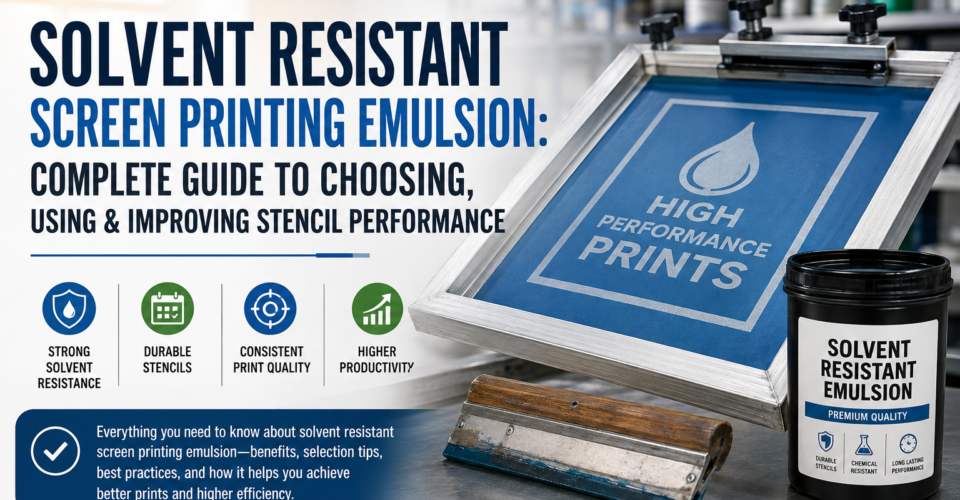
Screen printing is widely used for producing durable, high-quality prints across textiles, graphics, industrial products, packaging, labels, and other applications. However, achieving consistent print quality depends on more than ink, mesh, and printing equipment. The quality and performance of the stencil also play a critical role.
When solvent-based inks or chemically aggressive printing systems are involved, a standard emulsion may not provide the required stencil durability. This is where solvent resistant screen printing emulsion becomes important.
A solvent-resistant screen printing emulsion is designed to create a durable stencil that can withstand exposure to solvent-based inks and printing processes. The right emulsion can help printers maintain stencil integrity, improve print consistency, and reduce problems associated with premature stencil breakdown.
In this guide, we will explain what solvent resistant screen printing emulsion is, why it matters, its key benefits, how to choose the right emulsion, and how it can contribute to better screen printing performance.
What Is Solvent Resistant Screen Printing Emulsion?
Solvent resistant screen printing emulsion is a photosensitive coating used to create screen printing stencils with resistance to solvent-based printing inks and related chemicals.
During screen preparation, the emulsion is applied to the mesh and allowed to dry. The coated screen is then exposed to light through a positive or negative film, depending on the screen-making process. The exposed emulsion hardens while the unexposed areas can be washed out, creating the image area through which ink passes during printing.
For applications involving solvent-based inks, the stencil needs to maintain its structure when exposed to the chemicals present in the printing system. A suitable solvent resistant emulsion helps provide the durability required for these demanding printing conditions.
The result is a stencil that can support consistent ink transfer and reliable image reproduction throughout the printing process.
Why Is Solvent Resistance Important in Screen Printing?
The stencil is one of the most important components of a screen printing setup. If the emulsion begins to soften, break down, or lose adhesion during production, several printing problems can occur.
These problems may include:
- Loss of image definition
- Reduced stencil durability
- Inconsistent ink transfer
- Image distortion
- Increased screen maintenance
- Production interruptions
- More frequent screen replacement
For printers working with solvent-based inks, selecting an emulsion that is appropriate for the ink system is therefore essential.
A solvent resistant screen printing emulsion is designed to help the stencil maintain its performance when exposed to solvent-containing printing systems.
Key Benefits of Solvent Resistant Screen Printing Emulsion
Choosing the right emulsion can have a direct impact on stencil performance and overall printing efficiency.
1. Improved Stencil Durability
One of the primary benefits of solvent resistant screen printing emulsion is improved stencil durability.
A durable stencil can remain stable during printing and help maintain the intended image throughout the production process. This is particularly valuable for printers handling demanding jobs or longer production runs.
Better stencil durability can also reduce the need for frequent screen preparation and replacement.
2. Better Resistance to Solvent-Based Inks
Solvent-based inks can place additional chemical demands on the screen stencil.
A suitable solvent resistant emulsion is designed to provide better resistance to these conditions, helping the stencil retain its integrity during printing.
This can be particularly important when consistent performance is required across repeated printing cycles.
3. Consistent Print Quality
Stencil stability contributes to consistent ink transfer.
When the emulsion maintains its structure, the image opening remains more stable, helping printers achieve more predictable results from one print to another.
Consistent stencil performance can support:
- Clear image reproduction
- Defined edges
- Reliable ink deposition
- Repeatable print results
- Better production consistency
4. Reduced Production Interruptions
Stencil failure during production can result in downtime.
Replacing or repairing a damaged screen takes time and can interrupt the printing workflow. A suitable solvent resistant screen printing emulsion can help improve stencil reliability and reduce problems caused by premature stencil breakdown.
For commercial printers, maintaining a stable production workflow can be just as important as achieving high-quality individual prints.
5. Better Performance for Demanding Applications
Some screen printing applications require greater stencil durability because of the ink system, production volume, substrate, or printing conditions.
Solvent resistant emulsions can be a suitable choice for applications where ordinary stencil performance may not be sufficient.
The correct emulsion should always be selected according to the specific printing process, ink chemistry, mesh, exposure system, and production requirements.
6. Supports Reliable Screen Making
A high-quality screen begins with proper stencil preparation.
The emulsion plays an important role in converting the artwork into a usable printing stencil. Consistent coating, drying, exposure, and development can help produce a screen capable of delivering reliable printing results.
For professional printers, dependable screen making can contribute significantly to overall print quality.
How Does Solvent Resistant Screen Printing Emulsion Work?
The screen-making process generally involves several important stages.
Step 1: Screen Preparation
The screen mesh should be properly prepared before applying the emulsion. The mesh needs to be clean, dry, and suitable for the intended printing application.
Proper screen preparation helps improve coating consistency and stencil adhesion.
Step 2: Emulsion Coating
The emulsion is applied evenly across the mesh using an appropriate coating technique.
Uniform coating is important because variations in emulsion thickness can influence exposure, stencil resolution, and ink transfer.
Step 3: Drying
The coated screen must be dried under appropriate conditions.
The drying environment can affect the quality of the final stencil, so contamination, excessive humidity, and improper drying conditions should be avoided.
Step 4: Exposure
The dried emulsion is exposed to UV or suitable light through the artwork.
The exposure process hardens the appropriate areas of the emulsion and establishes the stencil image.
Correct exposure is important for achieving good stencil durability and image reproduction.
Step 5: Washing and Developing
After exposure, the screen is washed to remove the unexposed emulsion and reveal the image areas.
Careful development helps preserve fine details and maintain the intended stencil shape.
Step 6: Final Inspection
The completed screen should be inspected for pinholes, incomplete development, weak areas, or other defects before production begins.
A properly prepared stencil provides a stronger foundation for consistent printing.
What Should You Consider When Choosing Solvent Resistant Screen Printing Emulsion?
Selecting an emulsion should not be based only on the phrase “solvent resistant.” The printing process and production requirements should also be considered.
Ink Compatibility
The first consideration is the type of ink being used.
Different ink systems can have different chemical characteristics. The emulsion should therefore be compatible with the intended ink system and printing conditions.
Stencil Durability
Consider the expected production volume and the demands placed on the stencil.
For longer production runs, stencil durability can become particularly important.
Image Resolution
If the job includes fine details, small text, halftones, or intricate graphics, the emulsion should be capable of supporting the required image reproduction.
Exposure System
The emulsion should be compatible with the available exposure equipment and process.
Exposure conditions can influence stencil quality, so printers should follow the manufacturer’s recommended exposure guidelines.
Mesh Selection
Mesh count, thread diameter, mesh tension, and stencil thickness can influence ink deposition and image reproduction.
Photokina’s screen-printing training resources specifically highlight mesh geometry, tension calibration, emulsion coating techniques, exposure, and ink deposit as important parts of screen-making performance.
Reclaiming Requirements
For operations where screens are regularly reclaimed and reused, the balance between stencil durability and reclaimability should be considered.
The right choice depends on the production workflow and the number of screen cycles expected.
Common Problems When Using the Wrong Screen Printing Emulsion
Using an emulsion that is not suitable for the printing process can create several problems.
Stencil Breakdown
If the emulsion does not provide sufficient chemical resistance, the stencil may deteriorate during printing.
Loss of Image Detail
Stencil deterioration can affect the edges and details of the printed image.
Inconsistent Ink Transfer
Changes in the stencil opening can affect how ink passes through the screen.
Reduced Production Efficiency
Frequent screen repairs or replacements can increase downtime and production costs.
Difficult Troubleshooting
When the emulsion, ink, mesh, exposure, and coating process are not properly matched, identifying the source of a printing problem can become difficult.
For this reason, screen printing performance should be considered as a complete system rather than focusing on a single material.
How to Improve Stencil Performance
Choosing a solvent resistant screen printing emulsion is only one part of producing a reliable stencil.
Follow these practices to improve overall screen performance.
Maintain Proper Screen Preparation
Clean and properly prepared mesh provides a better foundation for emulsion coating.
Apply a Consistent Coating
Uneven coating can lead to variations in stencil thickness and exposure.
Use a controlled coating technique suitable for the mesh and printing application.
Control Drying Conditions
Allow the coated screen to dry properly before exposure.
Avoid conditions that can introduce contamination or affect the drying process.
Optimize Exposure
Underexposure and overexposure can both affect stencil performance.
Exposure should be established according to the emulsion, coating thickness, mesh, and exposure equipment.
Inspect Screens Before Printing
Check the stencil for pinholes, weak areas, incomplete development, and other visible defects.
Identifying issues before production can prevent wasted materials and downtime.
Match the Emulsion to the Ink
One of the most important steps is ensuring that the emulsion is appropriate for the ink system.
A solvent resistant screen printing emulsion is particularly relevant when solvent-based inks are part of the printing process.
Applications of Solvent Resistant Screen Printing Emulsion
Solvent resistant emulsions can be considered for screen printing applications where the stencil needs to withstand solvent-based ink systems.
Depending on the specific emulsion and its technical characteristics, applications may include:
- Industrial screen printing
- Graphic printing
- Label printing
- Packaging applications
- Specialty printing
- Sign and display printing
- Decorative printing
- Printing on selected non-porous substrates
The appropriate emulsion should always be selected based on the exact ink, substrate, mesh, exposure process, and production requirements.
Why Choose Photokina Chemicals for Screen Printing Solutions?
Photokina Chemicals has been active in the screen printing industry since 1985 and offers a broad range of screen-making auxiliaries, emulsions, accessories, fabrics, and related products. Its current emulsion range includes solutions designed for different printing requirements, including products described for solvent-, water-, UV-, and plastisol-based applications.
For printers looking for a solvent resistant screen printing emulsion, the key advantage is being able to work with a company focused specifically on screen printing chemistry and related screen-making processes.
Photokina’s experience also extends beyond products. Its Experience Center provides training covering screen preparation, coating, exposure, troubleshooting, mesh geometry, and ink deposit control.
Benefits of Choosing Photokina Chemicals
When selecting a screen printing emulsion, professional users can benefit from:
- Screen printing industry experience
- A broad range of emulsion solutions
- Focus on printing chemistry and screen making
- Support for different printing applications
- Technical guidance and training
- Solutions designed around professional printing requirements
- Access to related screen-making products and chemicals
The right technical support can be valuable when printers need to optimize coating, exposure, stencil durability, and overall print performance.
Frequently Asked Questions About Solvent Resistant Screen Printing Emulsion
What is solvent resistant screen printing emulsion?
Solvent resistant screen printing emulsion is a photosensitive coating used to create screen printing stencils designed to withstand solvent-based inks and related printing conditions.
Why use solvent resistant emulsion for screen printing?
It can help improve stencil durability and maintain stencil integrity when printing with solvent-based ink systems.
Is solvent resistant emulsion suitable for all screen printing inks?
Not necessarily. Emulsion selection should be based on the specific ink chemistry and printing process. Always verify compatibility with the emulsion manufacturer’s recommendations.
How does solvent resistant emulsion improve print quality?
A stable stencil can help maintain consistent image openings and ink transfer, supporting repeatable print quality throughout production.
Can solvent resistant emulsion be used for industrial screen printing?
It can be suitable for certain industrial screen printing applications, depending on the specific emulsion, ink system, substrate, and production requirements.
How can I improve the durability of a screen printing stencil?
Proper mesh preparation, consistent emulsion coating, controlled drying, correct exposure, thorough development, and suitable ink-emulsion compatibility can all contribute to stencil durability.
How do I choose the right screen printing emulsion?
Consider the ink system, required stencil durability, image resolution, mesh, exposure equipment, substrate, production volume, and reclaiming requirements.
Final Thoughts
Choosing the right solvent resistant screen printing emulsion can make an important difference to stencil durability, print consistency, and production efficiency.
For printers working with solvent-based inks, the emulsion needs to be considered as part of the complete screen printing process. Proper screen preparation, coating, drying, exposure, development, and maintenance all contribute to achieving reliable results.
The right emulsion can help printers maintain stronger stencils, reduce production interruptions, and achieve more consistent printing performance.
Photokina Chemicals provides a broad portfolio of screen printing emulsions and related screen-making solutions, supported by decades of experience in the screen printing industry.
If you are looking for a solvent resistant screen printing emulsion for your printing requirements, evaluate your ink system, mesh, exposure process, substrate, and production conditions before making a selection. Choosing an emulsion that fits your complete printing workflow can help you achieve more reliable and consistent results.